


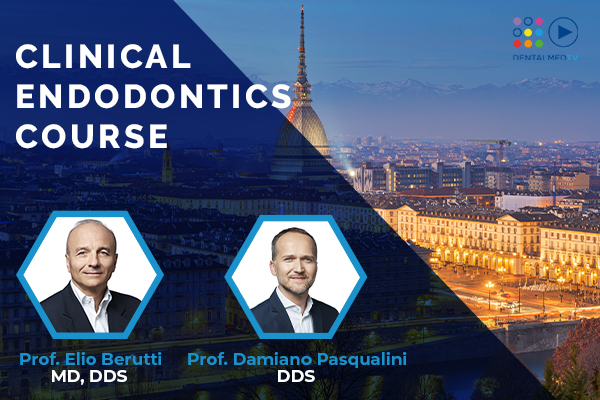
Description
PROGRAM
THE ACCESS CAVITY
- The importance of saving dental tissue: restorative and prosthetic implications.
- Simplified technique to create a correct and minimally invasive access cavity (incisors, canines, premolars and upper and lower molars).
- The use of ultrasonic inserts to finish the access cavity.
- Finding root canal orifices (MB2, calcified canals).
THE MINIMALLY-INVASIVE SHAPING OF THE ROOT CANAL SYSTEM
- The mechanical and biological objectives of H. Schilder.
- The determination of the working length. Electronic apex locator: correct use.
- Canal scouting: management of calcified canals and curvatures in the middle and apical third of the canal.
- NiTi rotary endodontic instruments: characteristics and classification.
- Torsional and bending stresses: how to avoid fracture of NiTi rotary instruments.
- Endodontic motors: settings and correct use.
- The importance of the Glide Path.
- Is it always possible to use NiTi rotary instruments to create the Glide Path?
- New strategies to achieve minimally invasive shaping.
- I Protaper Next i B-4U
- The right clinical choices in relation to anatomy.
THREE-DIMENSIONAL CLEANING OF THE ROOT CANAL SYSTEM
- Irrigants: their correct use.
- Irrigants activation systems.
- Times of action of irrigants in case of treatment in vital teeth, necrotic teeth or in retreatments.
THREE-DIMENSIONAL FILLING OF THE ROOT CANAL SYSTEM
- Biological reasons for root canal filling.
- The various filling techniques.
- The vertical compaction of the warm gutta-percha according to the H. Schilder.
- The “Continuous Condensation Wave” technique according to L.S. Buchanan.
- Carrier-based systems.
- Endodontic sealers: correct use in relation to the different techniques.
- Bioceramic sealers: the single cone technique.
- Properties, indications and use of the MTA: the apical plug
- Notes on pulp regeneration.


Reviews
There are no reviews yet.